
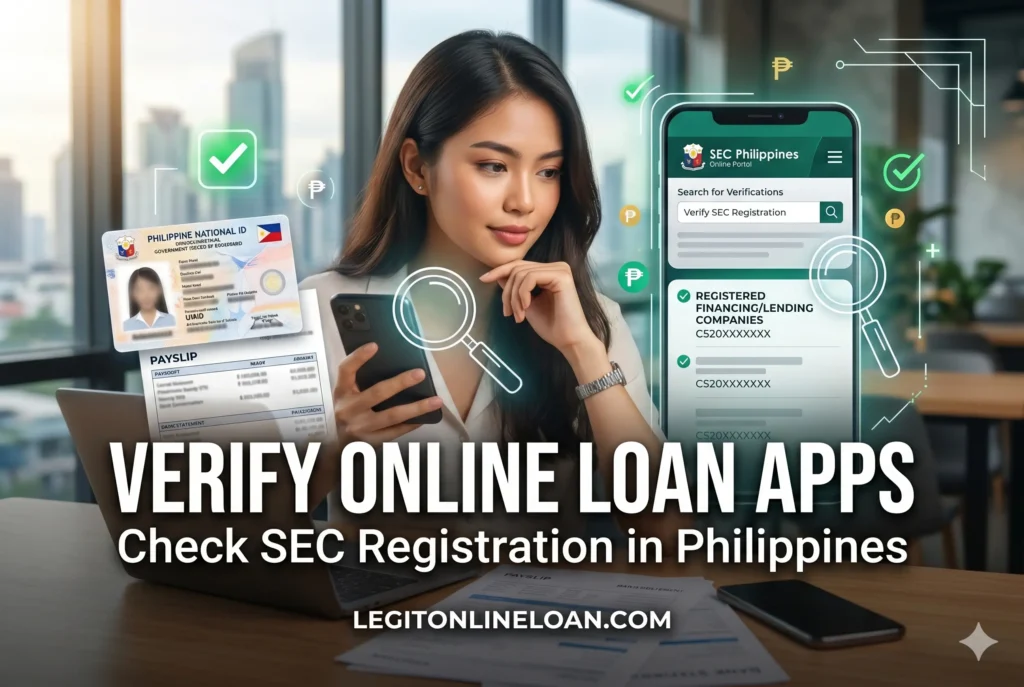
Many Filipinos now apply for loans directly through mobile apps instead of visiting physical lending offices. That convenience has also created a growing problem: fake lending apps, cloned APKs, misleading TikTok ads, and illegal operators pretending to be legitimate financial companies.
If you search for “quick cash loan Philippines” today, you will likely see dozens of apps claiming instant approval, low requirements, or guaranteed release within minutes. Some are legally registered. Others are not.
Learning how to verify SEC registered online loan app status before submitting your personal information is now one of the most important borrower protection habits in the Philippine digital lending ecosystem.
A legitimate-looking app icon alone is not proof that a lender is authorized to operate.
Many scam complaints begin with borrowers downloading an app that copied the branding, screenshots, or even the company name of a real lending corporation.
This article explains the exact verification process Filipino borrowers can use to independently validate whether an online lending app is connected to a legitimate lending company registered with the Securities and Exchange Commission (SEC) Philippines.
Summary
To verify a SEC registered online loan app in the Philippines, borrowers should confirm the lending company through the official SEC company database, compare the registered corporate name with the app publisher listed in the Google Play Store or Apple App Store, review SEC advisories, inspect licensing disclosures inside the app, and avoid APK downloads outside official app marketplaces. A legitimate app should clearly identify its lending corporation, registration details, privacy practices, and contact information. Verification reduces the risk of identity theft, harassment, fake collection tactics, and illegal lending activity.
Why SEC Verification Matters More Than Ever 📱
The Philippine online lending market expanded rapidly after mobile-first financial services became mainstream. Many borrowers now rely on app-based loans for:
- Emergency expenses
- Salary gaps
- Freelance cash flow interruptions
- Motorcycle maintenance for delivery riders
- E-wallet liquidity shortages
- Gig-economy income instability
At the same time, regulators began receiving complaints involving:
- Unauthorized contact harvesting
- Fake debt collection threats
- Identity misuse
- Excessive penalties
- App cloning
- Illegal lending operations
The SEC requires lending and financing companies operating digitally to register properly and comply with regulatory requirements before offering loans to the public.
However, many borrowers assume that an app appearing on the Google Play Store automatically means it is legal.
That assumption is dangerous.
Apps can temporarily appear on marketplaces before being reported or removed. Some illegal apps repeatedly re-upload under slightly different names after takedowns.
This is why borrower-side verification has become essential.
What “SEC Registered” Actually Means
A common misunderstanding is that every app itself is “registered.” In reality, the SEC registers the company behind the lending operation, not the mobile app alone.
That distinction matters.
A mobile application may use:
- A marketing brand name
- A shortened product name
- A separate app publisher account
- Multiple loan products under one corporation
The real entity borrowers must verify is the lending corporation or financing company operating the service.
Legitimate Lending Companies Usually Display:
- Corporate name
- SEC registration number
- Certificate of Authority details
- Contact information
- Privacy policy
- Terms and conditions
- Customer service channels
If these details are hidden, vague, or inconsistent, borrowers should pause immediately.
The Fastest Way to Verify a Loan App Legally Operates
Here is the quickest borrower workflow before installing or applying:
- Find the company name inside the app listing
- Search the company in the SEC database
- Compare names carefully
- Check for SEC advisories or warnings
- Confirm the app publisher matches the corporation
- Avoid APK downloads from external websites
- Review app permissions before installation
This process usually takes less than 10 minutes.
Step-by-Step: How to Verify a SEC Registered Online Loan App
Step 1: Identify the Real Company Behind the App
Many borrowers only remember the app name.
That is not enough.
For example:
- The app name may say “CashGo”
- The actual corporation could be “ABC Financing Inc.”
You need the legal corporate identity.
Where to Find the Company Name
Check:
- Google Play Store description
- Apple App Store developer information
- Privacy policy page
- Terms and conditions
- “About Us” section inside the app
- Official website footer
Look for phrases like:
- “Operated by”
- “Powered by”
- “Owned by”
- “A financing company registered with the SEC”
Red Flag 🚩
If the app only shows:
- Gmail addresses
- No company name
- No office address
- Social media contact only
- Telegram or WhatsApp support only
…that is a serious warning sign.
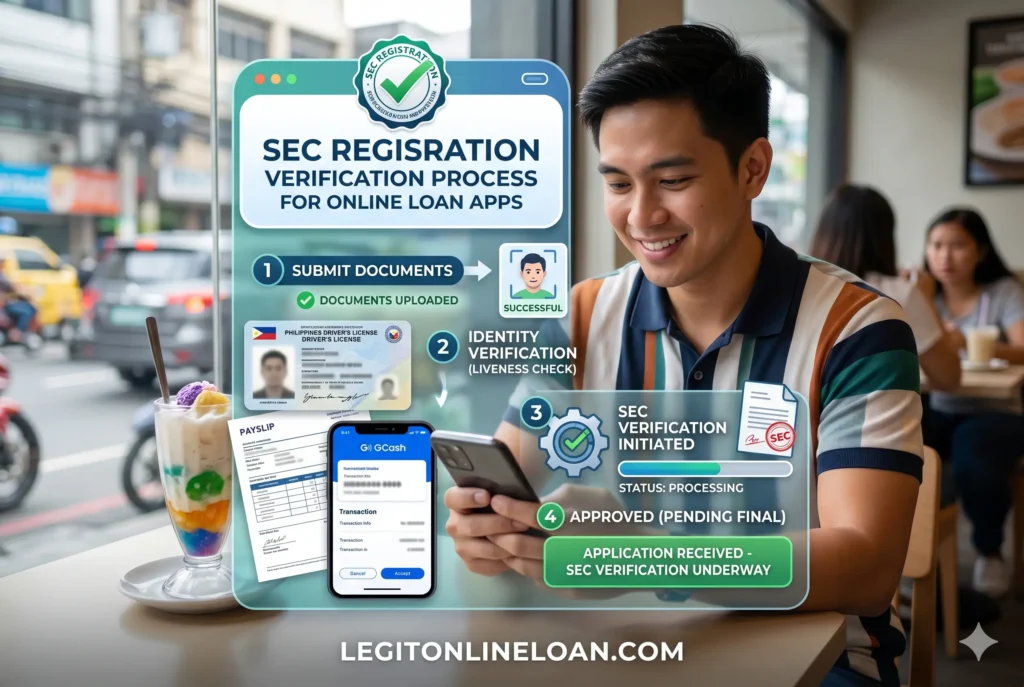
Step 2: Search the Official SEC Company Database
The next step is checking whether the company legally exists.
The Securities and Exchange Commission maintains corporate registration records for companies operating in the Philippines.
Borrowers should compare:
- Exact corporate spelling
- Business type
- Registration status
What Borrowers Often Miss
Some scam apps use names intentionally similar to real companies.
Example:
- “Fast Peso Lending Corporation”
- “Fast Pes0 Lending Corporation”
Notice the zero replacing the letter “o.”
These small changes are common in clone operations.
Verification Tip
Always copy the company name directly from:
- The privacy policy
- Terms page
- Official disclosures
Do not rely on memory alone.
Step 3: Check Whether the Company Has Lending Authority
Being registered as a corporation alone is not sufficient.
A company also needs proper authority to conduct lending or financing operations.
Borrowers should confirm whether the company:
- Operates as a lending corporation
- Holds financing authority
- Is included in regulatory disclosures
Some businesses are legally incorporated but are not authorized for digital lending activities.
That distinction is important because illegal operators sometimes hide behind unrelated business registrations.
Step 4: Compare the App Publisher Name Carefully
One of the most overlooked borrower safety checks involves the app publisher.
In the Google Play Store
Check:
- Developer name
- Contact email
- Website
- Privacy policy domain
In the Apple App Store
Check:
- Seller identity
- Developer account
- Linked support pages
Why This Matters
Clone apps frequently:
- Copy screenshots
- Reuse logos
- Mimic legitimate app names
But the publisher account often exposes inconsistencies.
Example:
- App claims to belong to “ABC Financing Inc.”
- Publisher shows “QuickDev Studio”
- Contact email uses random domains
That mismatch deserves investigation.
App Publisher Mismatch: A Common Scam Pattern ⚠️
Borrowers often focus only on:
- Star ratings
- Download count
- Loan amount promises
But fraud investigators and compliance teams usually inspect:
- Publisher identity
- Domain ownership
- Privacy disclosures
- Data handling practices
High-Risk Signals Include:
- Recently created developer accounts
- No verified company website
- Broken privacy policy links
- Recycled screenshots
- Multiple nearly identical apps from one publisher
- Excessive permission requests
Apps asking for:
- full contact list access,
- photo gallery access,
- microphone permissions,
- or unnecessary SMS permissions
should be reviewed carefully.
Legitimate lenders now increasingly follow tighter data privacy practices due to regulatory pressure and borrower complaints.
Why APK Downloads Are Extremely Risky
A major borrower mistake involves downloading APK files outside official app stores.
This often happens after:
- Clicking TikTok loan ads
- Receiving Facebook Messenger links
- Joining Telegram lending groups
- Seeing “fast approval” comments in social media threads
What Illegal APKs May Do
Some modified APKs can:
- Capture personal data
- Steal OTPs
- Inject malware
- Access device information
- Harvest contacts
Even if the company name appears legitimate, the APK itself may be altered.
Safer Practice ✔️
Only install apps from:
- Google Play Store
- Apple App Store
Avoid:
- Third-party APK websites
- Direct download links from comments
- Unknown QR codes
- Side-loaded installations
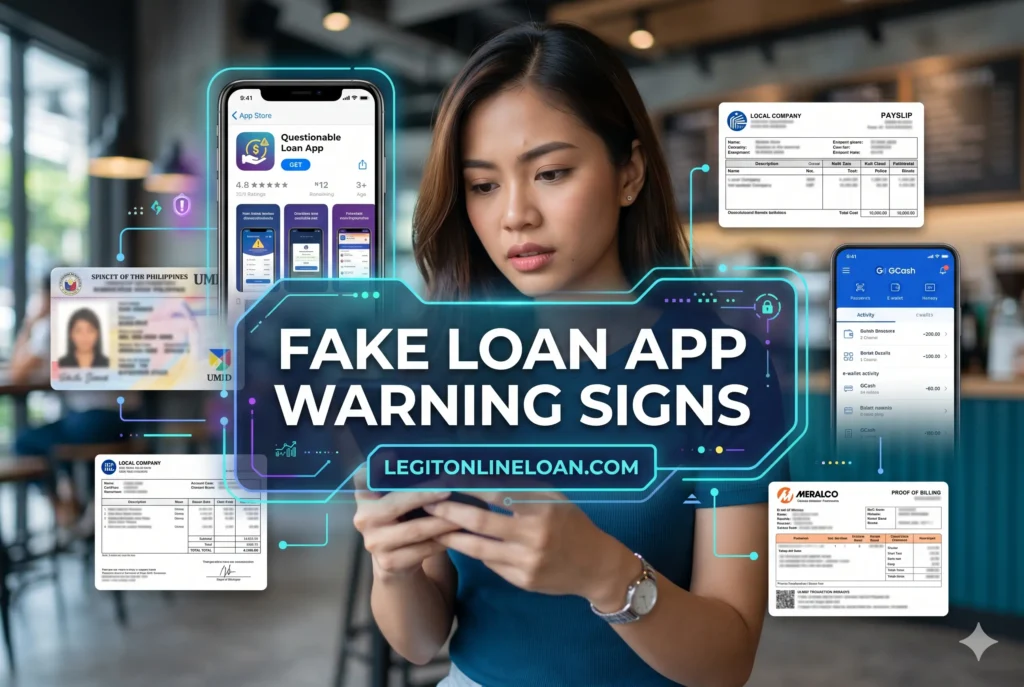
How Borrowers Can Spot Fake Lending Apps Quickly
Many illegal apps follow similar behavioral patterns.
Warning Signs Borrowers Frequently Ignore
Extremely Aggressive Approval Claims
Examples:
- “Guaranteed approval”
- “No verification needed”
- “Instant cash in 2 minutes”
- “Borrow now without documents”
Legitimate lenders still conduct risk checks, even if simplified.
Poorly Written Privacy Policies
Common issues:
- Broken English
- Generic templates
- Missing company identity
- No data retention explanation
Excessive Permission Requests
Modern legitimate lenders may request:
- Camera access for KYC
- Location access for fraud prevention
- SMS reading for device validation
But excessive access unrelated to lending activity should raise concern.
No Clear Repayment Structure
Illegal apps often hide:
- Interest computations
- Late payment penalties
- Processing fees
- Collection procedures
Transparent lenders disclose repayment structures before loan confirmation.
Why Some Legitimate Apps Use Different Brand Names
Borrowers often panic when:
- the app name,
- company name,
- and payment recipient
do not perfectly match.
In many cases, this is normal.
Operational Reasons for Different Names
A financing company may:
- operate multiple brands,
- outsource app development,
- use a parent company,
- or maintain separate collection entities.
For example:
- Marketing brand = “QuickCash”
- Legal corporation = “XYZ Financing Inc.”
This is why borrowers must verify the actual corporate entity instead of relying solely on branding.
Real Borrower Behavior That Often Leads to Scams
Many scam victims were not careless. They were rushed.
Common borrower patterns include:
- Applying late at night during emergencies
- Downloading apps while emotionally stressed
- Accepting links from social media comments
- Skipping terms and conditions
- Trusting influencer endorsements immediately
A borrower seeing a TikTok ad offering “instant salary loan without ID verification” may focus only on the urgency of the need.
Scam operators intentionally target that emotional pressure.
Verification habits create a pause between urgency and action.
That pause protects borrowers.
The Role of Google Play Reviews and App Store Feedback
User reviews are helpful, but they should not be treated as definitive proof of legitimacy.
Fake Review Patterns Exist
Some suspicious apps use:
- incentivized reviews,
- repetitive comments,
- or artificially inflated ratings.
More Useful Signals Include:
- Complaints about harassment
- Hidden deductions
- Sudden account lockouts
- Unauthorized contact access
- Repayment confusion
- Customer service disappearance
Recent review patterns matter more than old ratings.
Apps can change ownership or behavior over time.
SEC Advisories and Regulatory Notices Matter
The SEC periodically releases advisories involving:
- unauthorized lenders,
- abusive collection practices,
- and illegal digital lending behavior.
Borrowers should review whether:
- the company appears in public warnings,
- operations were suspended,
- or the app was previously flagged.
This is especially important because some apps continue marketing despite prior complaints.
Why “Removed from Google Play” Does Not Always Mean the Risk Is Gone
Many borrowers assume that once an app disappears, the operation ends.
Unfortunately, illegal operators frequently:
- rename apps,
- rebrand logos,
- create new developer accounts,
- or relaunch through APK distribution.
This is why borrowers researching loan apps removed from Google Play should focus on the company identity behind the platform, not just the app icon.
A removed app may reappear under:
- different spelling,
- alternate branding,
- or cloned interfaces.
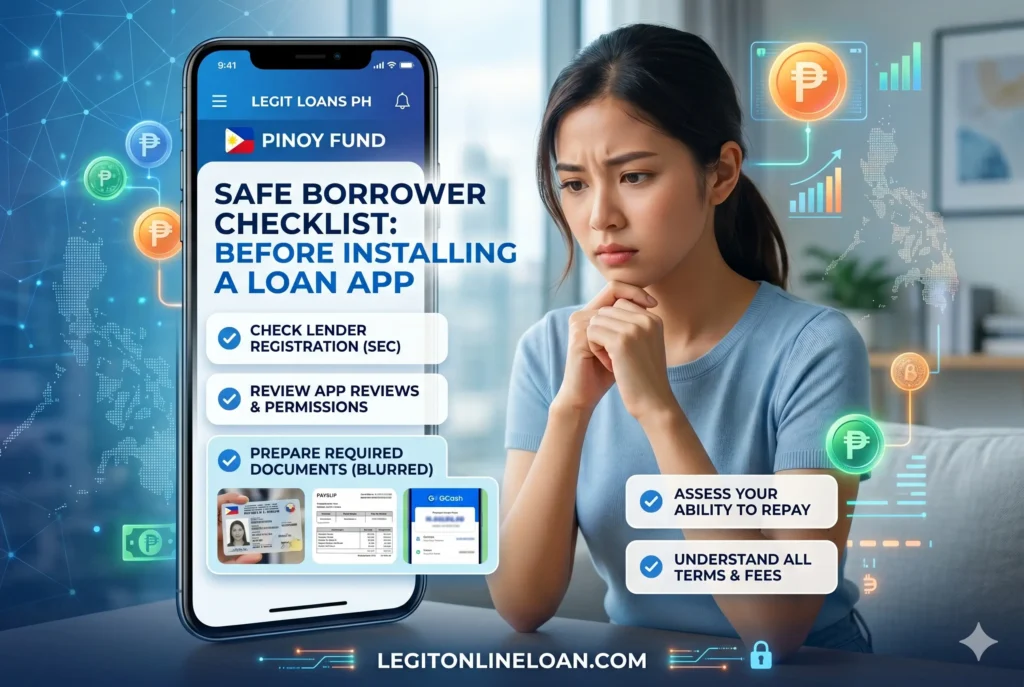
Practical Verification Checklist Before Applying ✔️
Use this checklist every time before borrowing.
| Verification Item | What to Check |
|---|---|
| Company identity | Full legal corporation name |
| SEC registration | Company exists in SEC records |
| Lending authority | Proper financing/lending authority |
| App publisher | Matches company disclosures |
| Official marketplace | Available on Google Play or App Store |
| Privacy policy | Functional and specific |
| Contact information | Real address and support channels |
| Permissions | Reasonable device access only |
| Regulatory warnings | No active advisories or suspension |
| Repayment disclosure | Transparent fees and due dates |
Are All SEC Registered Companies Automatically Safe?
No.
This is an important distinction.
A company may be legally registered yet still receive complaints involving:
- poor customer service,
- aggressive collections,
- unclear fees,
- or operational problems.
SEC registration confirms legal existence and authorization status. It does not guarantee perfect borrower experience.
Borrowers should still evaluate:
- repayment transparency,
- customer feedback,
- privacy practices,
- and communication quality.
This is why many users research:
legit online loan apps with SEC registration instead of relying only on registration status alone.
How Modern Lending Apps Verify Borrowers
Legitimate digital lenders now use more advanced onboarding systems.
Borrowers may encounter:
- selfie verification,
- facial matching,
- OTP validation,
- device fingerprinting,
- e-wallet verification,
- and AI-assisted fraud screening.
Why These Systems Exist
Lenders attempt to reduce:
- identity fraud,
- duplicate accounts,
- synthetic identities,
- and repayment abuse.
This means legitimate apps usually collect enough information to satisfy:
- KYC obligations,
- anti-fraud controls,
- and risk assessment processes.
Ironically, fake apps often either:
- request far too much invasive access,
- or almost no verification at all.
Both extremes can indicate risk.
Borrowers in the Gig Economy Should Be Extra Careful
Freelancers, riders, online sellers, and gig workers are heavily targeted by suspicious lenders because many need fast liquidity and may not have traditional payslips.
Some fake apps intentionally advertise:
- “No employment needed”
- “No bank account required”
- “Instant freelancer cash”
Legitimate lenders may still accommodate non-traditional income earners, but they usually request alternative proof such as:
- e-wallet transaction history,
- platform earnings,
- delivery app income,
- or digital bank statements.
That operational difference matters.
Where to Check for Fake Lending App Warning Signs
Borrowers researching fake lending app warning signs should inspect multiple layers of information rather than trusting advertisements alone.
Best Places to Review Before Applying
- Official app marketplaces
- SEC disclosures
- Privacy policies
- Developer websites
- Recent app reviews
- Customer complaint discussions
- Regulatory advisories
A single red flag may not confirm fraud.
But multiple inconsistencies together should stop the application process immediately.
What To Do If You Already Downloaded a Suspicious App
If you believe an app may be unsafe:
- Stop submitting personal information
- Uninstall the app
- Change sensitive passwords
- Monitor SMS activity
- Watch e-wallet and banking accounts
- Remove unnecessary app permissions
- Report suspicious activity through proper channels
If sensitive IDs or selfies were uploaded, borrowers should remain alert for identity misuse attempts.
Conclusion
Verifying whether an online loan app is legally connected to a SEC-registered lending company is now a basic digital safety habit for Filipino borrowers.
The safest borrowers are not necessarily the most financially experienced. They are usually the ones who slow down long enough to validate:
- company identity,
- regulatory status,
- app publisher information,
- and disclosure transparency.
A professional-looking app, influencer endorsement, or viral TikTok advertisement should never replace independent verification.
Before submitting IDs, selfies, contacts, or bank details, always confirm that the lender behind the app can be traced through legitimate corporate and regulatory records.
Responsible borrowing starts before the application button is pressed.
Last Updated: May 29, 2026
| Online Loans | Amount |
| 🔰️ Online Loans US | $100 – $5,000 |
| 🔰️ Online Loans UK | $100 – $5,000 |
| 🔰️ Online Loans Pilipinas | ₱ 1000 – ₱ 25,000 |
| 🔰️ Vay Tiền Online VN | 1 triệu – 14 triệu VNĐ |
| 🔰️ Online Loans Sri Lanka | Rs 8000 – Rs 50,000 |
| 🔰️ Préstamos Online México | $ 1,000 – $ 150,000 |
| 🔰️ Préstamos Online en España | 50€ – 300€ |
| 🔰️ Pożyczki Online Polska | 500 PLN – 15000 PLN |
