
Many borrowers panic when they discover that an online loan app they previously used has suddenly disappeared from Google Play. Others become concerned when a lender’s name can no longer be found on regulatory lists maintained by the Securities and Exchange Commission (SEC) in the Philippines. While app removal or regulatory delisting does not automatically mean a lender is fraudulent, it is often an important warning signal that deserves careful evaluation.
The Philippine digital lending industry has matured significantly over recent years. Regulators, app marketplaces, and consumer protection agencies have become more active in identifying problematic lenders, privacy violations, abusive collection practices, impersonation schemes, and compliance failures. As a result, borrowers are increasingly encountering situations where a lending app suddenly changes its name, becomes unavailable for download, or disappears altogether.
Summary
When an online loan app removed from Google Play is no longer available, the removal may stem from policy violations, security concerns, compliance issues, publisher actions, business restructuring, or regulatory enforcement. Removal alone does not automatically prove illegality, but it should trigger a careful review of the lender’s legitimacy, SEC registration status, repayment channels, privacy practices, and customer support availability. Borrowers should verify regulatory standing, preserve transaction records, continue fulfilling valid loan obligations, monitor personal data security, and avoid assuming that app disappearance cancels outstanding debt. The safest approach is to confirm the lender’s current legal status through official Philippine regulatory channels and documented repayment methods.
Why Do Online Loan Apps Suddenly Disappear?
Many borrowers assume that Google Play only removes apps that are scams. The reality is more nuanced.
The Android ecosystem contains millions of applications managed by thousands of app publishers. Google continuously monitors these applications using automated detection systems, policy reviews, security assessments, and consumer complaint investigations.
An app may disappear because of:
- Policy enforcement actions
- Security violations
- Developer account suspensions
- Regulatory concerns
- Voluntary publisher withdrawal
- Business restructuring
- Rebranding initiatives
- Technical platform issues
- Duplicate or impersonation app detection
The key question is not simply whether the app disappeared.
The important question is why it disappeared.
The Difference Between Google Play Removal and SEC Delisting
One of the biggest misconceptions among borrowers is treating platform removal and regulatory delisting as identical events.
They are not.
| Event | Meaning | Risk Level |
|---|---|---|
| Google Play removal | App unavailable on Google Play | Depends on cause |
| SEC delisting | Regulatory status changed or authorization issue | Potentially serious |
| Both occur simultaneously | Multiple risk indicators | High concern |
| Voluntary app withdrawal | Publisher chooses removal | Moderate concern |
| Rebranding with continuity | Business migration | Requires verification |
A lender can remain legally registered while temporarily unavailable on Google Play.
Conversely, an app can remain downloadable while regulatory issues exist behind the scenes.
This distinction is critical for borrowers assessing trustworthiness.
How Google Play Protect Influences Lending App Removals
Google uses systems such as Google Play Protect to identify potentially harmful applications.
These reviews can focus on:
- Excessive permissions
- Malware risks
- Data misuse
- Deceptive behavior
- Unauthorized access requests
- Impersonation activities
- Hidden software functionality
Many digital lending applications require access to:
- Camera
- SMS verification
- Device identifiers
- Selfie verification tools
These permissions alone do not trigger removal.
Problems arise when permissions exceed legitimate lending requirements or violate marketplace policies.
As enforcement standards evolve, apps that previously operated without issue may suddenly face suspension notices or corrective action requests.
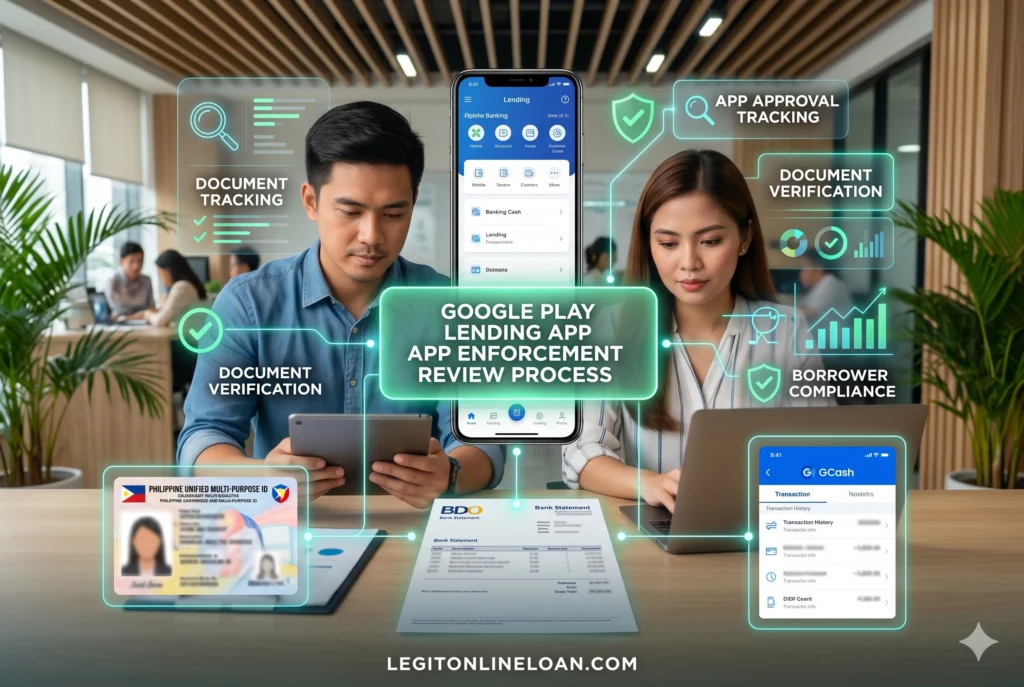
What SEC Enforcement Actions May Indicate
In the Philippines, the SEC continues to strengthen oversight of digital lending activities.
SEC enforcement units generally focus on:
Registration and Licensing Issues
Some operators may market loan products without maintaining required registrations or authorizations.
In such cases, enforcement actions can include:
- Suspension orders
- Revocation actions
- Public advisories
- Compliance directives
Consumer Protection Concerns
Regulators pay close attention to:
- Harassment complaints
- Privacy violations
- Misleading advertising
- Improper collection tactics
- Unauthorized disclosure of borrower information
Borrowers often first notice regulatory issues when apps disappear, customer support becomes unreachable, or repayment instructions change unexpectedly.
Is a Removed App Automatically Illegal?
Short Answer
No.
An app being removed from Google Play does not automatically mean it is illegal.
Why the Answer Is More Complicated
Several legitimate situations can lead to removal:
Business Restructuring
Some lenders migrate to:
- New app versions
- New publisher accounts
- New corporate entities
- Different distribution channels
Compliance Updates
Developers occasionally remove apps while updating:
- Privacy policies
- Permission frameworks
- Security controls
- Regulatory disclosures
Platform Policy Changes
Google periodically updates lending-related policies.
A previously compliant application may require modifications before reinstatement.
Serious Violations
At the same time, removals can result from genuine problems including:
- Data misuse
- Consumer complaints
- Misrepresentation
- Unlicensed lending activity
This is why borrowers should investigate rather than immediately assume either innocence or guilt.
How Borrowers Can Verify Whether a Lender Is Still Legitimate
When an app disappears, trust should be re-earned through verification.
Check Regulatory Records
Review official records and current regulatory information.
This is also a good time to learn how to verify SEC registered apps before continuing any relationship with a lender.
Look for consistency between:
- Company name
- Corporate registration details
- Contact information
- Lending disclosures
Verify Customer Support Channels
Legitimate lenders generally maintain:
- Email support
- Customer service hotlines
- Official websites
- Repayment instructions
A sudden disappearance of all communication channels is more concerning than an app removal alone.
Compare Historical Information
Look for changes involving:
- Brand names
- Logos
- Corporate identities
- Repayment destinations
Large unexplained changes deserve additional scrutiny.
App Name Changes After Complaints: A Common Industry Pattern
One pattern occasionally observed in digital lending markets is lender migration behavior.
This may involve:
- New app names
- New publisher accounts
- Modified branding
- New download listings
Not every rebrand is suspicious.
However, borrowers should investigate if:
- Reviews disappear overnight
- Customer support changes dramatically
- Repayment channels suddenly shift
- Previous company information becomes difficult to locate
Sometimes operators attempt to distance themselves from poor reputations. Other times, companies genuinely refresh branding after mergers or compliance changes.
The distinction becomes clear through documentation and transparency.
What Happens If You Already Have an Active Loan?
Many borrowers fear that app removal affects their obligations.
Existing Debt Usually Does Not Disappear
If a loan agreement remains valid, removal from Google Play generally does not erase repayment responsibilities.
Borrowers should continue documenting:
- Loan contracts
- Payment receipts
- Transaction histories
- Collection communications
Request Alternative Payment Channels
Legitimate lenders usually provide replacement methods such as:
- Bank transfers
- E-wallet payments
- Payment centers
- Web portals
Keep Written Records
Maintain evidence of:
- Repayment attempts
- Customer support inquiries
- Screenshots
- Official notices
Documentation becomes valuable if disputes arise later.
Borrower Locked Out of an Account After App Removal
This is one of the most stressful situations borrowers face.
A user may open their phone and discover:
- App unavailable
- Login failure
- Verification errors
- Missing account access
First Steps to Take
- Preserve existing screenshots.
- Save repayment confirmations.
- Contact official support channels.
- Document all communications.
- Avoid making payments to unverified replacement accounts.
What Not to Do
Do not rely solely on:
- Social media rumors
- Anonymous online posts
- Unverified repayment instructions
Fraudsters sometimes exploit confusion following app removals.
User Concern: Could My Personal Data Be Exposed?
Data privacy concerns often emerge when lending apps disappear.
Many borrowers remember providing:
- Government IDs
- Selfies
- Employment information
- Device data
- Contact details
Risk Does Not Automatically Increase
Removal itself does not prove a data breach occurred.
However, borrowers should increase vigilance if:
- Collection activity becomes unusual
- Unknown entities contact them
- Identity verification requests suddenly appear
- Suspicious financial activity emerges
Practical Protective Measures
Consider:
- Updating passwords
- Monitoring financial accounts
- Watching for phishing attempts
- Reviewing privacy-related communications
Borrowers should remain alert without assuming the worst.
Enforcement Patterns Seen Across Digital Lending Markets
Although every case differs, several recurring patterns appear in enforcement actions globally.
Pattern 1: Complaint-Driven Reviews
High volumes of borrower complaints may trigger deeper scrutiny.
Pattern 2: Policy Enforcement Waves
Platform operators occasionally conduct large-scale app takedowns targeting entire categories.
Pattern 3: Identity and Impersonation Issues
Impersonation apps may copy:
- Legitimate brands
- Logos
- Interfaces
- Marketing materials
Pattern 4: Data Handling Violations
Privacy-related concerns frequently attract both platform and regulatory attention.
These patterns explain why sudden app disappearances sometimes affect multiple lenders simultaneously.
Can Removed Apps Return to Google Play?
Yes.
App reinstatement cases occur regularly.
The outcome depends on:
- Severity of violations
- Corrective actions taken
- Policy compliance improvements
- Security remediation efforts
Common Reinstatement Triggers
Apps may return after:
- Updating permissions
- Improving disclosures
- Correcting policy breaches
- Passing security reviews
Therefore, a removal should be viewed as an important signal—not necessarily a permanent verdict.
Red Flags That Should Trigger Extra Caution 🚨
An app removal becomes more concerning when combined with other warning signs.
Examples include:
- No working customer support
- Missing corporate information
- Constant name changes
- Unexplained repayment account changes
- Aggressive collection behavior
- Lack of regulatory transparency
Borrowers should compare these indicators with common fake online lender warning signs rather than evaluating the disappearance in isolation.
The greater the number of warning signals, the more cautious a borrower should become.
Quick Assessment Checklist
Ask the following questions:
Low-Risk Indicators
✔ Official support still responds
✔ Existing repayment channels remain operational
✔ Company information remains consistent
✔ Regulatory information remains verifiable
✔ Transparent public communication exists
Higher-Risk Indicators
✖ No support responses
✖ Brand identity repeatedly changes
✖ Repayment instructions suddenly change
✖ Regulatory records become difficult to verify
✖ Borrowers report widespread access problems
This simple framework often provides more insight than the removal itself.
Why Trustworthy Lenders Prioritize Transparency During Enforcement Events
Well-managed lending companies recognize that borrower confidence can collapse quickly after an app suspension.
As a result, reputable operators often provide:
- Public announcements
- Customer notifications
- Repayment continuity plans
- Support updates
- Compliance explanations
Transparency is frequently a stronger trust signal than the app’s marketplace status alone.
Borrowers researching SEC registered lending apps Philippines should pay close attention to how companies communicate during disruptions, not merely whether the app remains downloadable.
Frequently Asked Questions
Why do online loan apps disappear suddenly?
Apps may disappear because of platform policy enforcement, security reviews, publisher decisions, compliance updates, technical issues, regulatory concerns, or rebranding efforts. The specific reason determines the actual risk level.
Can I still repay my loan if the app is gone?
In many cases, yes. Legitimate lenders usually maintain alternative repayment methods through websites, banks, e-wallets, or customer support channels. Always verify payment instructions before sending funds.
Should I stop paying because the app was removed?
Not automatically. If a valid loan agreement exists, repayment obligations may remain enforceable. Preserve documentation and seek verified repayment instructions.
What if customer support disappears too?
The risk profile increases significantly. Maintain records, attempt documented communication, and verify the lender’s regulatory standing through official channels.
Can an app return after being removed?
Yes. Some apps are reinstated after resolving policy issues, security concerns, or compliance deficiencies.
Conclusion
A disappearing lending app can be alarming, but borrowers should avoid jumping to conclusions. An online loan app removed from Google Play is not automatically illegal, nor does it automatically remain trustworthy. The real answer lies in the reason behind the removal, the lender’s regulatory status, the transparency of its communications, and its ability to continue serving borrowers responsibly.
The most effective response is a disciplined one: verify regulatory standing, preserve repayment records, maintain documentation, monitor personal data security, and avoid acting on rumors. Responsible borrowers treat app removals as a signal to reassess trust, not as proof of guilt or innocence. In a rapidly evolving Philippine fintech environment, informed verification remains one of the strongest forms of borrower protection.
Last Updated: May 31, 2026
| Online Loans | Amount |
| 🔰️ Online Loans US | $100 – $5,000 |
| 🔰️ Online Loans UK | $100 – $5,000 |
| 🔰️ Online Loans Pilipinas | ₱ 1000 – ₱ 25,000 |
| 🔰️ Vay Tiền Online VN | 1 triệu – 14 triệu VNĐ |
| 🔰️ Online Loans Sri Lanka | Rs 8000 – Rs 50,000 |
| 🔰️ Préstamos Online México | $ 1,000 – $ 150,000 |
| 🔰️ Préstamos Online en España | 50€ – 300€ |
| 🔰️ Pożyczki Online Polska | 500 PLN – 15000 PLN |
