
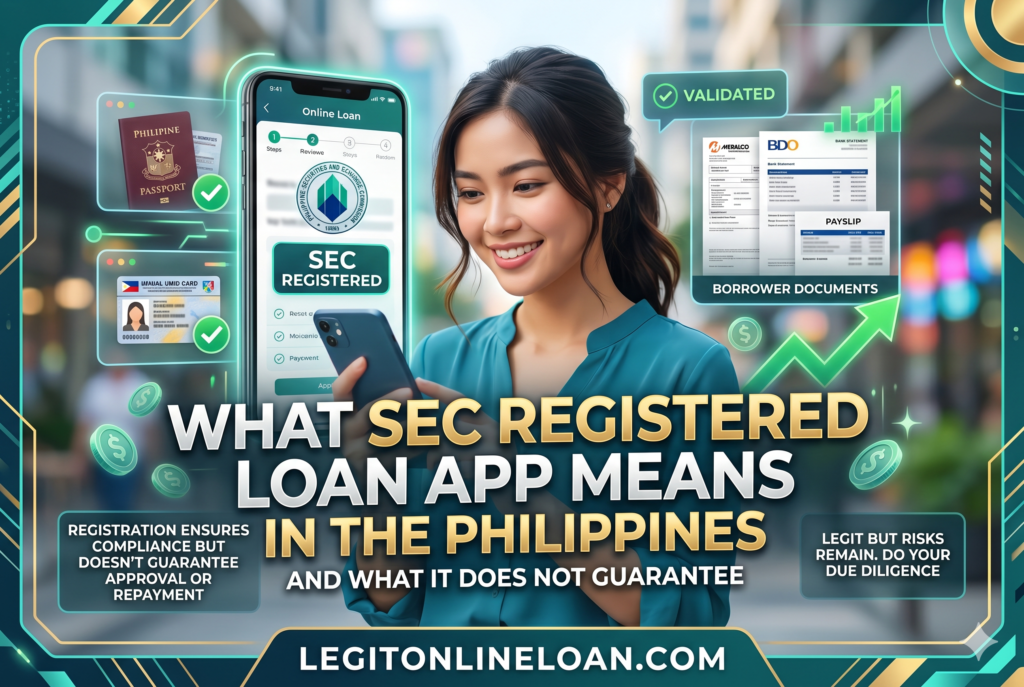
Many Filipinos see the phrase “SEC Registered” on a loan app and immediately assume it is safe, government-approved, low-risk, or fully trustworthy. That assumption is one of the biggest reasons borrowers still encounter abusive collection practices, excessive fees, misleading advertisements, and privacy concerns despite dealing with legally registered lenders.
The reality is more nuanced.
A loan app being registered with the Philippine Securities and Exchange Commission (SEC) means it has met certain legal and regulatory requirements to operate. However, SEC registration alone does not guarantee fair interest rates, automatic borrower protection, ethical collections, approval certainty, or high service quality.
For borrowers trying to evaluate lender legitimacy, knowing exactly what SEC registration means – and what it does not mean – is one of the most important financial literacy skills in the Philippine digital lending ecosystem.
Summary
The phrase what SEC registered loan app means refers to a lending or financing company that has legally registered with the Philippine Securities and Exchange Commission and secured the required authority to operate. SEC registration confirms legal existence and regulatory oversight, but it does not guarantee loan approval, low interest rates, ethical customer service, or complete borrower safety. Borrowers should verify both the company’s registration status and its Certificate of Authority, review lending terms carefully, examine privacy practices, monitor collection behavior, and perform additional legitimacy checks before borrowing through any online lending platform.
Why So Many Borrowers Misinterpret SEC Registration
The phrase “SEC Registered” has become a powerful trust signal in Philippine fintech marketing.
Many mobile lending apps place SEC numbers prominently on:
- App store descriptions
- Facebook advertisements
- Landing pages
- Loan application screens
- SMS marketing campaigns
The problem is that borrowers often translate this into assumptions that regulators never intended.
Common borrower assumptions include:
- The government guarantees the loan company
- Interest rates are automatically reasonable
- Approval is guaranteed
- Collection practices are always fair
- Personal data is fully protected
- The app cannot engage in abusive behavior
None of those assumptions are automatically true.
The SEC regulates legal operation and compliance requirements, but registration is only one layer of lender legitimacy.
What SEC Registration Actually Means
Legal Existence of the Corporation
At its most basic level, SEC registration confirms that a company legally exists as a corporation under Philippine law.
The company has:
- Filed incorporation documents
- Registered corporate information
- Identified directors and officers
- Submitted required legal records
This creates accountability because regulators know who owns and operates the business.
Without registration, an online lending operator may be functioning completely outside legal regulatory structures.
Authority to Engage in Lending Activities
A critical distinction many borrowers miss is that business registration alone is not enough.
A corporation can exist legally without having authority to offer loans.
For lending activities, companies generally need additional authorization such as a Certificate of Authority (CA) issued under relevant lending and financing regulations.
This distinction matters because some borrowers only verify a company name and assume that automatically means the lending operation itself is authorized.
In reality:
| Verification Item | What It Means |
|---|---|
| SEC Registration | Company legally exists |
| Certificate of Authority | Company can legally engage in lending or financing |
| Recorded Online Lending Platform | Specific online platform has been disclosed to regulators |
A borrower who checks only one of these may miss important warning signs.
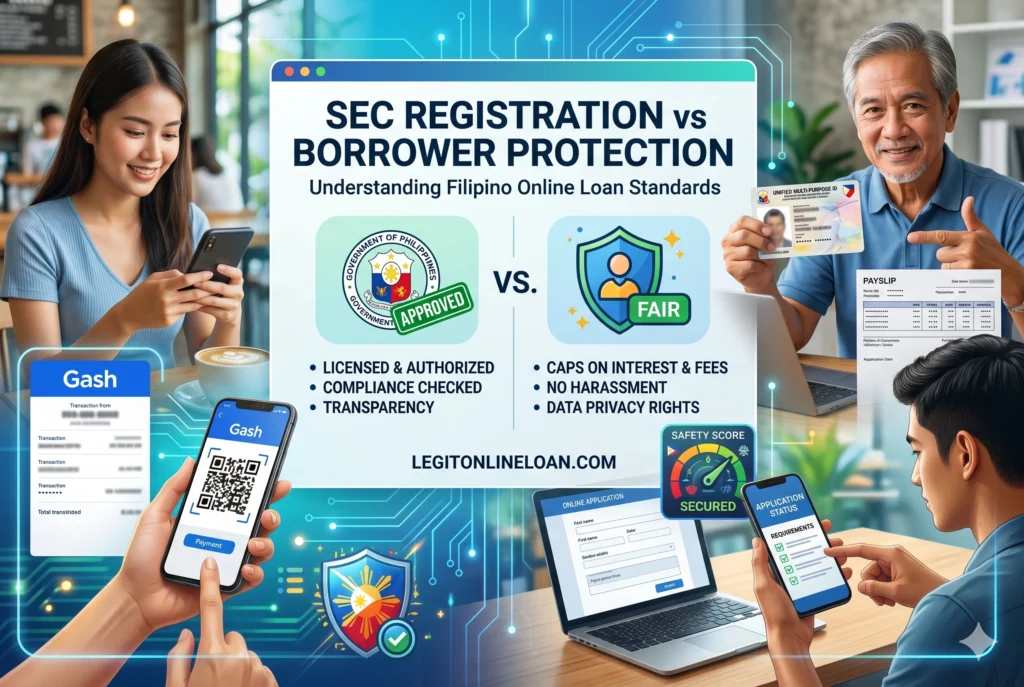
The Difference Between Registration and Borrower Protection
One of the biggest regulatory misconceptions is believing registration equals protection.
Registration creates accountability.
Protection depends on many additional factors.
What Registration Helps Regulators Do
SEC oversight allows regulators to:
- Monitor corporate compliance
- Investigate complaints
- Issue advisories
- Suspend or revoke authority
- Require disclosures
- Track responsible officers
This creates a legal framework that does not exist with completely illegal lenders.
What Registration Does Not Automatically Prevent
Registration does not guarantee:
- Instant dispute resolution
- Affordable borrowing costs
- Fast complaint outcomes
- Good customer service
- Responsible marketing
- Proper borrower budgeting
Borrowers still need to evaluate risks independently.
Many complaints filed against online lending apps involve companies that were legally registered at some point. Community discussions frequently show borrowers reporting concerns about harassment, collection pressure, or expensive loan structures even when lenders appear on official lists.
🚩 The Dangerous Myth: “SEC Registered Means Government-Backed”
This misunderstanding appears frequently in borrower communities.
A user sees:
SEC Registered
Then interprets it as:
Government approved and guaranteed.
Those are not the same thing.
The SEC is a regulator.
It is not guaranteeing:
- Your loan outcome
- Your financial success
- Your repayment ability
- The company’s future performance
Think of SEC registration similarly to how a driver’s license authorizes someone to drive.
A driver’s license does not guarantee the person will never cause an accident.
Likewise, regulatory authorization does not guarantee perfect lender behavior.
What Legitimate SEC-Regulated Loan Apps Are Expected to Do
While registration is not a perfect trust guarantee, legitimate operators are generally expected to maintain compliance obligations.
These often include:
Corporate Transparency
Borrowers should be able to identify:
- Corporate name
- Registration details
- Business address
- Contact channels
Anonymous operators create significantly higher risk.
KYC and Identity Verification
Most legitimate digital lenders now use modern onboarding systems such as:
- Selfie verification
- Government ID validation
- Facial matching technology
- Device fingerprinting
- OTP verification
- Mobile number validation
These controls help reduce fraud and identity theft.
In practice, borrowers often encounter verification failures because:
- Selfies are poorly lit
- IDs are blurry
- Names do not match records
- SIM registration details differ
- Device integrity checks fail
These are operational risk controls, not necessarily signs of lender misconduct.
Complaint Management Systems
Regulated lenders are expected to maintain channels where borrowers can raise concerns.
Many consumers overlook these mechanisms until a dispute occurs.
Can SEC-Registered Apps Still Charge High Interest?
Yes, They Can
One of the most searched borrower questions is whether registration limits interest rates.
The answer is simple:
SEC registration alone does not guarantee low borrowing costs.
A lender may still charge:
- Processing fees
- Service fees
- Penalty fees
- Daily interest structures
- Short-term loan pricing
Borrowers often focus on the advertised loan amount instead of examining:
- Net disbursement received
- Total repayment amount
- Effective borrowing cost
- Due date structure
This creates situations where borrowers feel shocked by repayment obligations even though disclosures technically existed.
Why Borrowers Miscalculate Loan Costs
A common application pattern looks like this:
A borrower requests ₱10,000.
After deductions, they receive less than the requested amount.
The repayment obligation remains based on contractual terms.
The borrower focuses on cash received rather than total obligation.
This misunderstanding is one reason responsible lenders increasingly emphasize disclosure screens during onboarding.
Why Some Registered Loan Apps Still Receive Complaints
Being registered and being popular are not the same thing.
Being registered and being complaint-free are also not the same thing.
Large lending platforms naturally generate:
- More applications
- More rejected borrowers
- More collection interactions
- More customer support tickets
As a result, even regulated lenders may accumulate negative reviews.
Collection Practices Create Most Borrower Complaints
Historically, borrower complaints have centered around:
- Aggressive reminders
- Frequent calls
- Reference contact disputes
- Data privacy concerns
- Public shaming allegations
Philippine regulators have repeatedly issued actions and advisories against problematic lending practices.
The key lesson for borrowers is that registration should be viewed as a starting point for evaluation – not the final decision factor.
The Difference Between a Registered Company and a Recorded Loan App
This distinction causes enormous confusion.
A borrower may find:
- A legitimate company name
- A legitimate SEC number
But still encounter an unauthorized app.
How?
Because scammers increasingly create:
- Copycat mobile apps
- Fake Facebook pages
- Fake websites
- Fake app store listings
- Fake SEC badges
Recent SEC advisories have warned consumers about platforms using names that resemble legitimate lenders while lacking authorization.
This means verifying the company alone is no longer enough.
You must also verify the specific platform.
For borrowers learning how to verify SEC registration of loan apps, checking the recorded online lending platform itself is just as important as checking the company behind it.
Fake SEC Badges Are Becoming More Sophisticated
A growing fraud pattern involves fake compliance displays.
Examples include:
- Invented registration numbers
- Edited certificates
- Borrowed company information
- Fake regulator logos
- Screenshots copied from legitimate lenders
Many borrowers never verify the information independently.
Instead, they trust what appears inside the application.
That is exactly what fraud operators expect.
If a lender displays SEC information, borrowers should compare it with official records rather than relying solely on the app interface.
This is also why many lender reviews now include discussions around fake loan app red flags instead of focusing exclusively on approval speed.
What Protections Do Borrowers Actually Have?
The real protections available to borrowers are broader than SEC registration.
Regulatory Complaint Channels
Borrowers may be able to raise concerns through:
- SEC complaint systems
- Privacy-related channels
- Consumer protection mechanisms
These systems exist because regulators recognize that misconduct can occur even among licensed operators.
Data Privacy Rights
A regulated lender is still expected to respect privacy obligations.
Borrowers should be cautious when apps request:
- Entire contact lists
- Excessive permissions
- Unnecessary device access
Modern lenders increasingly rely on alternative fraud detection technologies instead of broad contact harvesting.
Documentation and Disclosure Requirements
Legitimate lenders generally provide:
- Terms and conditions
- Loan disclosures
- Repayment schedules
- Fee explanations
Borrowers who skip these documents often misunderstand their obligations later.
What Smart Borrowers Check Beyond Registration ✔️
The safest approach is layered verification.
Do not stop at SEC status.
Review the following:
Corporate Legitimacy
Check:
- Corporate name
- Authority status
- Recorded platform details
Loan Economics
Review:
- Total repayment amount
- Due dates
- Penalties
- Processing deductions
Privacy Practices
Look for:
- Permission requests
- Data collection disclosures
- Privacy notices
Reputation Patterns
Read:
- App store reviews
- Borrower experiences
- Complaint themes
Focus on recurring operational issues rather than isolated emotional reviews.
Support Accessibility
Legitimate lenders should provide:
- Customer support channels
- Email contacts
- Formal complaint processes
This is one reason many borrower education resources now discuss broader legit online loan app safety checks rather than relying exclusively on registration status.
Why Approval Is Never Guaranteed Even If a Lender Is Registered
Another major misconception:
Registered lender = guaranteed approval.
This is false.
Most modern digital lenders use automated risk assessment systems.
These systems evaluate:
- Identity confidence
- Employment stability
- Income consistency
- Repayment history
- Device signals
- Fraud indicators
Gig workers, freelancers, online sellers, and self-employed borrowers can still qualify, but they are often evaluated differently than salaried employees.
For example:
- A freelancer may submit bank transaction history.
- A ride-hailing driver may provide platform earnings.
- An online seller may show e-wallet cash flow patterns.
Registration status does not change how underwriting decisions work.

Quick Checklist Before Applying for Any Loan App
Use this five-step process:
- Verify corporate registration.
- Confirm lending authority status.
- Check the recorded online platform.
- Review loan costs carefully.
- Examine reviews and complaint patterns.
If any step creates uncertainty, pause before submitting sensitive information.
Remember:
A legitimate lender wants informed borrowers.
Fraudulent operators prefer rushed decisions.
Frequently Asked Questions
Does SEC registration guarantee loan approval?
No.
Registration only confirms legal authorization and regulatory compliance requirements. Approval depends on underwriting rules, income assessment, identity verification, risk scoring, and fraud checks.
Can SEC-registered apps still charge high interest?
Yes.
Registration does not automatically make loans inexpensive. Borrowers should evaluate total repayment obligations, fees, penalties, and loan duration before accepting any offer.
Is a registered loan app automatically safe?
Not necessarily.
Registration is an important trust signal, but borrowers should also evaluate privacy practices, complaint history, customer support quality, platform authenticity, and overall transparency.
What if an app shows an SEC number but feels suspicious?
Verify the information independently through official SEC resources.
Scammers increasingly imitate legitimate lenders using copied names, fake certificates, and misleading branding.
Can a registered company have an unauthorized app?
Yes.
A legitimate corporation can be impersonated by fake websites, fake mobile applications, or unauthorized online platforms. Always verify the exact platform being used.
Conclusion
The answer to what SEC registered loan app means is far more nuanced than many borrowers realize.
SEC registration confirms that a company has entered a regulated legal framework and is subject to oversight requirements. That matters. It creates accountability and gives borrowers stronger avenues for verification and complaint resolution compared with dealing with illegal lenders.
However, registration should never be treated as a complete safety guarantee.
Responsible borrowing requires evaluating the lender’s authority status, platform authenticity, loan costs, privacy practices, customer support quality, and borrower feedback patterns. The safest borrowers are not those who trust every app displaying an SEC number – they are the ones who verify information carefully, read disclosures thoroughly, and make lending decisions based on multiple trust signals rather than a single regulatory label.
Last Updated: June 1, 2026
| Online Loans | Amount |
| 🔰️ Online Loans US | $100 – $5,000 |
| 🔰️ Online Loans UK | $100 – $5,000 |
| 🔰️ Online Loans Pilipinas | ₱ 1000 – ₱ 25,000 |
| 🔰️ Vay Tiền Online VN | 1 triệu – 14 triệu VNĐ |
| 🔰️ Online Loans Sri Lanka | Rs 8000 – Rs 50,000 |
| 🔰️ Préstamos Online México | $ 1,000 – $ 150,000 |
| 🔰️ Préstamos Online en España | 50€ – 300€ |
| 🔰️ Pożyczki Online Polska | 500 PLN – 15000 PLN |
